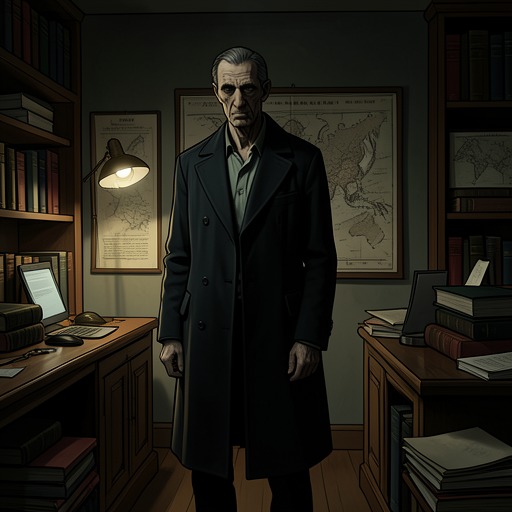
Nazi racial-hygiene ideology and population policy
The Disappearance of Josef MengeleNazi racial-hygiene ideology and population policy made the classification and management of human beings appear to be a scientific and national duty. In the book, that framework connects claims about heredity and social utility to state violence: Mengele presents selection and murder as medical service, while the treatment of prisoners and the circulation of research materials expose the human cost hidden by that language. Its postwar afterlife is equally central. Even after universities withdrew his degrees, Mengele continued to defend the system that had shaped his work, while some of its prominent advocates resumed academic and public careers.
Ideological Foundations
The ideology described in the book treats race, bloodlines, and biological inheritance as foundations for social and political order. Mengele’s later account of his generation presents biology as a guide to law, war, sex, international relations, and medicine. He links the ideal of a healthy, racially pure population to a larger Nazi project of purifying society, acquiring Lebensraum, and perfecting human beings. These are his explanations of the system, not neutral descriptions of scientific fact: the narrative shows how claims of biological necessity served to legitimize political goals and violence.
The language of social fitness is especially consequential. In Mengele’s reasoning, people he classified as inferior, unproductive, or parasitic could be excluded from the community and denied the protection ordinarily associated with human life. He later insisted that such elimination was encouraged by the system, permitted by law, and carried out as a state enterprise. This defense turns an ideological judgment into an alleged administrative obligation, obscuring the choices and responsibility of the people who acted on it.
Selection and Medical Practice at Auschwitz
At Auschwitz concentration camp, racial-hygiene ideology was enacted through selection. Mengele stood at the arrival platform and directed deportees according to whether they would be sent to forced labor or killed. The routine and scale of these decisions gave a medical appearance to a process that determined who would live and who would die. The book emphasizes the contrast between Mengele’s professional identity and the consequences of his work: he treated the selections as service to German medicine and as a patriotic duty, while the people subjected to them were reduced to categories of utility.
The same framework governed experiments on twins and dwarfs in the camp. Prisoners were subjected to tests without consent, and the work treated their bodies as material for research rather than as persons entitled to protection. The experiments could end in death; the requirement that twins be examined together did not restrain the process but intensified its instrumental logic. The narrative thereby exposes the gulf between scientific vocabulary and ethical practice: research conducted under a medical title did not become legitimate through that title.
Research materials also connected the camp to institutions beyond it. Organs were sent to the Institute for Anthropology, Human Heredity and Eugenics in Dahlem, Berlin, directed by Otmar von Verschuer, Mengele’s former mentor. The packages were marked as urgent war material, a bureaucratic designation that placed the transfer within a larger research and wartime apparatus. The relationship between Mengele’s experiments and the institute makes clear that the camp’s abuses were not presented as isolated acts detached from academic science; materials obtained through violence entered a network of institutional research.
Mentors, Institutions, and Postwar Continuities
Mengele’s mentors illuminate the intellectual and professional connections behind his work. Eugen Fischer, a prominent theorist of eugenics and an inspiration to Hitler, had participated in the Herero and Namaqua Genocide and later retired in Freiburg im Breisgau. He published memoirs and retained an honorary position in the German Anthropological Society. Von Verschuer, after directing the Kaiser Wilhelm Institute for Anthropology, Human Heredity and Eugenics and receiving material from Mengele, became a professor of human genetics and dean at the University of Münster, and headed a major genetic research center in West Germany.
The narrative sets these careers against Mengele’s account of abandonment. He remembered sharing Nazi sympathies with von Verschuer, including their attendance at a screening of the antisemitic film Der ewige Jude. After the war, however, von Verschuer destroyed correspondence and incriminating archives and did not answer Mengele’s letters from Argentina. Neither he nor Fischer was prosecuted. Their professional reintegration contrasts with Mengele’s fugitive life, but it does not make his own account reliable: the book presents his bitterness at their escape from scrutiny alongside his continuing refusal to acknowledge his responsibility for murder.
Defense, Disavowal, and Consequences
In 1964, Mengele received news in a letter from Martha that the universities of Frankfurt and Munich had withdrawn his doctoral degrees in medicine and anthropology. The stated grounds were his violation of the Hippocratic Oath and the murders committed at Auschwitz. He experienced the decision as the destruction of his qualifications and the discrediting of his research, not as a reason to reconsider the ideology behind either. He burned the letter and left the plantation, carrying his grievance into the surrounding landscape with his dogs.
His response folds personal loss into political self-exoneration. He blamed Germany for abandoning the biological principles he believed had governed his education and insisted that he had fulfilled a duty shared by his generation. He also contrasted his own flight and poverty with the comfortable postwar lives of industrialists and former colleagues whom he accused of profiting from Auschwitz. The complaint reveals a striking reversal: he cast himself as the victim of a society that had once authorized the very system he continued to defend.
Years later, when Rolf asked what he had done at Auschwitz, Mengele again described his actions as military duty in the service of German science. He claimed that he had tried to select as many people as possible for work and thereby save lives, and argued that the killings were required by the camp’s laws and conditions. Rolf did not accept this explanation, though he allowed his father to continue speaking in the hope that he might admit guilt or express regret. Instead, Mengele insisted that he had obeyed orders and was only one cog in a larger mechanism. The exchange makes the ideology’s enduring function plain: it supplied not only the language of policy and research, but also a vocabulary with which the perpetrator could deny personal responsibility after the crimes had been exposed.